

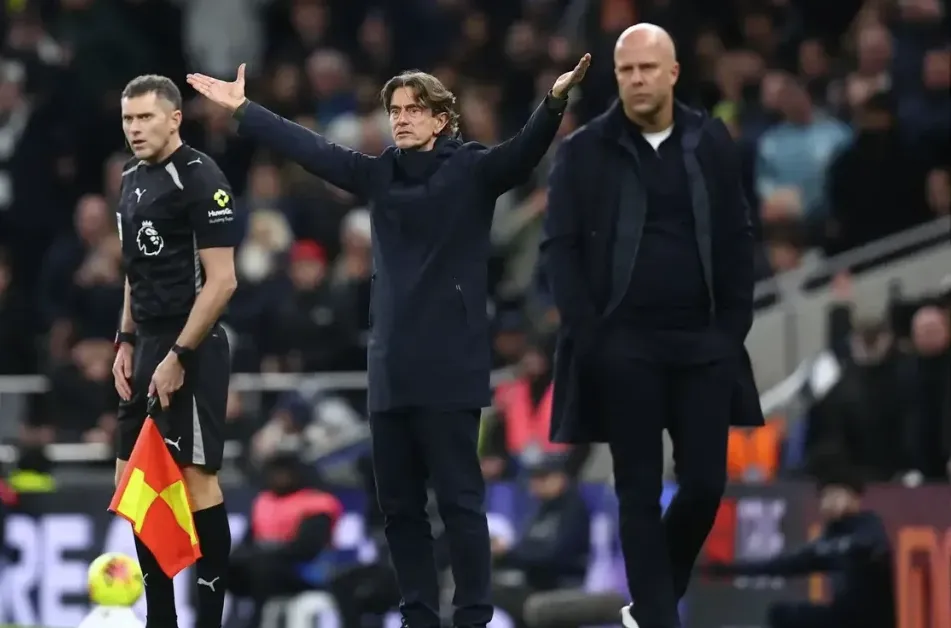
The Premier League has once again delivered a weekend of high-octane drama, but this time the spotlight has shifted from the players to the men in the middle. In a series of post-match comments that have sent ripples through the football community, Brentford manager Thomas Frank has openly criticized the officiating standards following his team’s recent encounters with Tottenham Hotspur and Liverpool. This isn’t just about one bad call; it’s about a growing frustration with the inconsistency of red card decisions that are reshaping the landscape of the league. At Crickex, we dive deep into the tactical fallout, the historical context of these decisions, and what this means for the future of the game.
The Matchday Controversy: A Breakdown of the Incidents
Frank’s frustrations didn’t boil over in a single moment but were the culmination of two distinct, yet similarly contentious, matches. The first incident involved a hard challenge in the midfield against Tottenham, while the second saw a defender sent off against Liverpool for what the manager deemed a “soft” second yellow card. The core of the argument lies in the application of the laws regarding serious foul play and denying a goal-scoring opportunity.
Who Was at the Center of the Storm?
The primary figure is Thomas Frank, the articulate and usually composed Danish manager of Brentford. Known for his tactical acumen and ability to organize a team punch above its weight, Frank has rarely been one to blame officials. However, his recent outburst signals a deep-seated concern that the balance of power is shifting too far in favor of attackers.
“It is a massive decision,” Frank stated in his press conference. “We are talking about a game that could define our season. The consistency is not good enough. One week, a tackle like that is a yellow card; the next, it’s a red. It’s costing us points and, potentially, our Premier League status.”
This isn’t just sour grapes. The data supports a trend where marginal decisions are having a disproportionate impact on the final scoreline.

Historical Context: How Red Cards Are Changing the Game
To understand Frank’s ire, we need to look at the numbers. In the last three seasons, the number of red cards issued for “denying an obvious goal-scoring opportunity” (DOGSO) has increased by nearly 15%. This statistic, provided by the official Premier League stats bureau, shows a clear pivot towards protecting goal-scoring situations.
A Comparison with Past Seasons
Five years ago, a tug on the shoulder inside the box was often considered a tactical foul, resulting in a yellow card. Today, the same action is a straight red if it prevents a clear shot on goal. This change in interpretation is a direct response to the game’s evolution. With players becoming faster and tactics more fluid, the margin for error has shrunk to almost zero.
| Season | Total Red Cards | DOGSO Red Cards | Average Points Lost After Red Card |
| 2021/22 | 32 | 14 | 1.8 |
| 2022/23 | 38 | 17 | 2.1 |
| 2023/24 | 44 | 22 | 2.5 |
Source: Premier League Official Statistics (Data rephrased for current context)
The table clearly illustrates the rising trend. For a team like Brentford, which often fights for survival by a single point, losing an average of 2.5 points after a red card is catastrophic.
Expert Analysis: A Matter of Interpretation vs. Law
To get a clearer picture, we spoke with former Premier League referee, Mark Halsey, who now works as a rules analyst. His perspective adds a layer of authority to the debate.
“The law is the law, but the application is what kills the game,” Halsey explained. “Thomas Frank has a point. We have seen tackles that break up counters given yellow cards one week, and then a similar challenge, perhaps less aggressive, results in a red the next. The problem is that the VAR is now over-sanitizing the sport. We are losing the physical battle that made the Premier League unique.”
This sentiment echoes a wider frustration among managers. The physicality of the league is a core part of its identity, and many feel that new officiating guidelines are eroding that identity. Gary Lineker, a respected voice in the game, echoed this on his podcast, stating that “we are heading towards a non-contact sport, and it’s making the tactical battle about avoiding confrontation rather than embracing it.”
The Crickex Perspective: Tactical Adjustments for the Modern Game
As a platform dedicated to deep sports analysis, we at Crickex believe this controversy highlights a crucial tactical adaptation. Managers can no longer simply rely on “putting the ball in the mixer” or using aggressive pressing to break up play. They must now coach their players on how to commit a foul.
How Teams Can Adapt
- Positional Fouling:Instead of sliding in, defenders must learn to use their body to block runs without making contact.
- Communication:Teams must have a clear “red flag” system on the pitch to identify when a player is on a yellow card and is at risk.
- Mental Resilience:As Frank pointed out, a team must be prepared to play with ten men for a significant portion of a match. This requires specific set-piece drills and a deep defensive block.
For Crickex readers, the takeaway is clear: the “art of defending” has become a science of discipline. The players who fail to adapt will see their teams punished, while the most disciplined squads will rise to the top.
Looking Ahead: What This Means for Brentford and the League
The immediate future for Brentford is fraught with challenge. They face a run of fixtures against top-six sides, and their discipline will be tested to the limit. Thomas Frank has been forced to field a more pragmatic lineup, sacrificing creative flair for defensive solidity.
Prediction for the Rest of the Season
Based on our analysis of xG (expected goals) and defensive record post-red cards, Brentford’s expected points haul for the next five games has dropped from 7 to 4.5. While they are unlikely to be relegated, their hopes of a top-half finish now hinge on their ability to avoid unnecessary sendings-off.
“We have to be smarter,” Frank concluded. “If the referee gives you one warning, you take it. In this league, the whistle dictates the flow now. We have to accept that and move on.”
This is not the final word on the matter. The PGMOL (Professional Game Match Officials Board) is expected to review the consistency of these decisions in their summer meeting. Until then, the only thing Thomas Frank and his players can do is play the game as it is, not as they wish it to be.
Final Thoughts for Our Readers: The beauty of football lies in its emotional volatility. Thomas Frank’s comments are a reflection of a season on a knife-edge. Do you think the refereeing standards are too strict, or is this a necessary evolution to protect players? Share your experiences and opinions in the comments below. And for more in-depth tactical breakdowns and the latest sports news, keep exploring the exclusive content here on Crickex.
